
Understanding Compound Interest: The Complete Guide
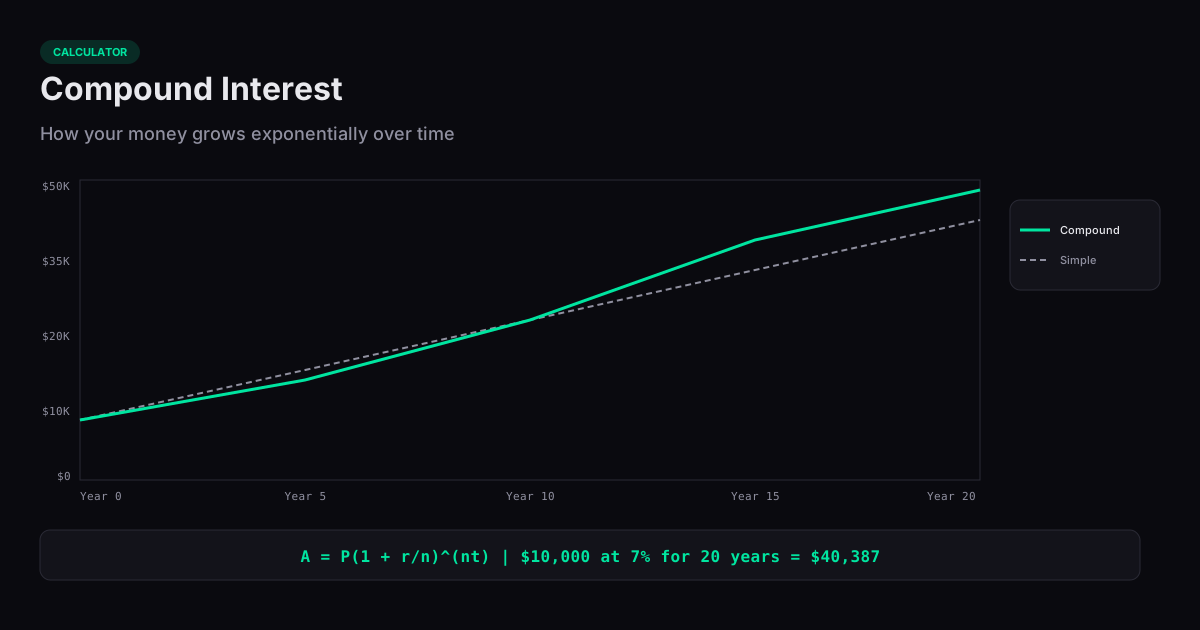
Understanding how compound interest works is essential for making informed decisions about savings, investments, and debt. Unlike simple interest, which is calculated only on the original principal, compound interest earns interest on previously accumulated interest — creating exponential growth that accelerates over time.
The Compound Interest Formula
The formula is A = P(1 + r/n)^(nt), where A is the final amount, P is the principal (starting amount), r is the annual interest rate (as a decimal), n is the number of compounding periods per year, and t is the number of years. For example, $10,000 invested at 7% annual interest compounded monthly for 30 years grows to approximately $81,165.
The same $10,000 with simple interest at 7% for 30 years would only reach $31,000. That $50,000 difference is entirely from compound interest — interest earned on interest, accumulating over three decades.
How Compounding Frequency Affects Growth
Interest can compound annually, semi-annually, quarterly, monthly, daily, or even continuously. More frequent compounding produces slightly higher returns because earned interest starts generating its own interest sooner. However, the difference between monthly and daily compounding is minimal — the big jump is from annual to monthly.
For a $10,000 investment at 5% over 10 years: annual compounding yields $16,289, monthly compounding yields $16,470, and daily compounding yields $16,487. The difference between monthly and daily is only $17. For practical purposes, monthly compounding captures nearly all the benefit.
The Rule of 72
The Rule of 72 is a quick mental math shortcut for estimating how long it takes to double your money. Divide 72 by the annual interest rate to get the approximate doubling time in years. At 6% interest, your money doubles in roughly 12 years (72 / 6 = 12). At 8%, it doubles in about 9 years.
This rule highlights why starting early matters so much. An investment that doubles every 10 years will double four times in 40 years — turning $10,000 into $160,000. Waiting 10 years to start means one fewer doubling, cutting the final amount roughly in half.
Compound Interest and Debt
Compound interest works against you on debt. Credit card interest typically compounds daily on unpaid balances. A $5,000 credit card balance at 20% APR, if you only make minimum payments, can take over 20 years to pay off and cost more than $8,000 in interest alone. Understanding this dynamic is the strongest argument for paying off high-interest debt as aggressively as possible before focusing on investments.
Related Tools
Compound Interest Calculator
Calculate how investments grow over time with compound interest.
Mortgage Calculator
Calculate monthly mortgage payments, total interest, and amortization schedules.
Loan Calculator
Calculate monthly loan payments and total repayment amounts.
Retirement Calculator
Estimate your retirement savings and when you can retire comfortably.