
Isolated vs Cross Margin in Crypto: Which Is Safer for Leverage Trading?
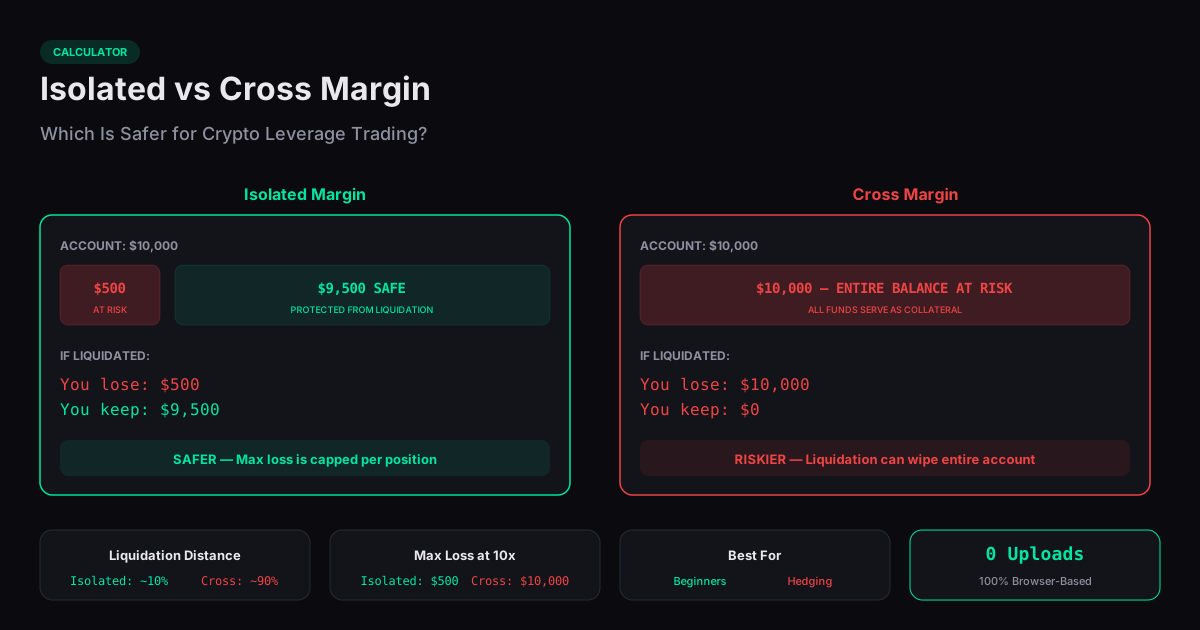
Every crypto exchange that offers leverage trading asks you to choose between isolated margin and cross margin before opening a position. This choice determines how much of your account is at risk if the trade goes wrong. Isolated margin puts only the assigned margin at risk. Cross margin puts your entire available balance at risk. Choosing the wrong mode is one of the most common and costly mistakes in leverage trading.
What Is Isolated Margin?
In isolated margin mode, you assign a fixed amount of margin to each position. That margin is the maximum you can lose on that trade. If BTC drops and your 10x long position hits its liquidation price, you lose only the margin allocated to that position — for example, $500 on a $5,000 position. The rest of your account balance ($9,500 if you have $10,000 total) is completely untouched.
This makes isolated margin the safer default for most traders. Each position is independent — a bad trade on one pair cannot drain your account. The trade-off is that your liquidation price is closer to your entry price, because less margin is backing the position. You can manually add more margin to an isolated position to push the liquidation price further away.
What Is Cross Margin?
In cross margin mode, your entire available account balance serves as collateral for all open positions. This gives each position a much lower liquidation price — there is more margin backing it. A 10x long on BTC with $500 initial margin but $10,000 in your account means the exchange uses the full $10,000 as effective collateral.
The danger is obvious: if the market moves hard against your position, you can lose your entire account balance — not just the initial margin. Cross margin is used by experienced traders who run hedged strategies (long one pair, short another) where positions offset each other. For directional bets, it is significantly more dangerous than isolated margin.
How Liquidation Differs Between Modes
In isolated margin, liquidation price depends only on the margin assigned to that position. With $500 margin on a 10x BTC long at $60,000, liquidation hits around $54,300. In cross margin with $10,000 total balance, the effective margin is much larger, pushing the liquidation price down to around $6,000 — a 90% drop.
This sounds like cross margin is better — you get liquidated less easily. But when liquidation does happen in cross margin, you lose everything. In isolated margin, you lose $500. In cross margin, you lose $10,000. Use our liquidation price calculator to see the exact liquidation price for both modes before entering a trade.
When to Use Each Mode
Use isolated margin when: you are making a directional bet (pure long or short), you are a beginner to leverage trading, you want to cap your maximum loss per trade, or you are trading volatile assets with high liquidation risk. This should be your default mode.
Use cross margin when: you are running hedged positions (long BTC, short ETH) where gains on one offset losses on the other, you are an experienced trader who actively manages positions, or you specifically need a wider liquidation buffer for a high-confidence trade. Never use cross margin without understanding that your entire balance is at risk.
Settings on Major Exchanges
On Binance Futures, you can toggle between isolated and cross margin for each trading pair independently. The setting is above the order form — make sure to check it before every trade as it may default to cross. On Bybit, the margin mode selector is in the top-right of the trading panel. OKX lets you set margin mode per position in the order settings.
All three exchanges allow you to switch margin modes only when you have no open positions in that pair. You cannot switch from isolated to cross while a trade is active. Plan your margin mode before entering the trade.
Related Tools
Crypto Liquidation Calculator
Calculate your liquidation price for leveraged crypto positions on Binance, Bybit, and OKX.
Crypto Position Size Calculator
Calculate the right position size based on your account balance, risk tolerance, and stop loss.
Crypto Profit Calculator
Calculate crypto profit, loss, ROI, and net returns after trading fees.