
How Crypto Liquidation Works: A Complete Guide to Leverage Risk
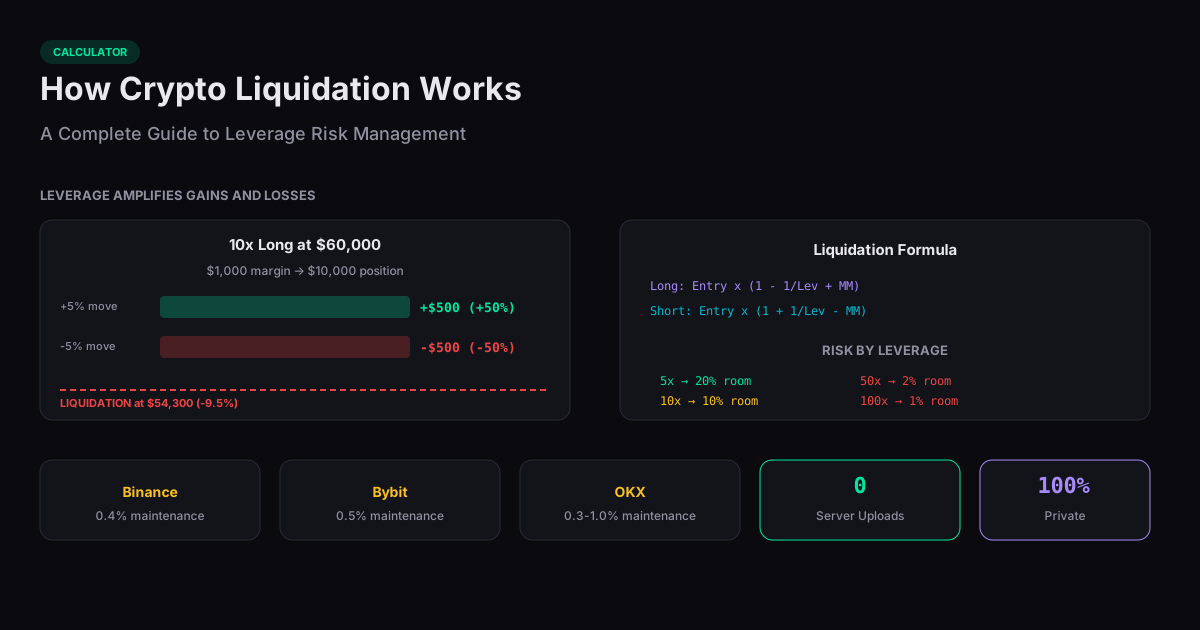
Crypto liquidation is the forced closure of a leveraged trading position when your losses eat through the margin you deposited. It is the number one reason new leverage traders lose their entire account in a single trade. Understanding exactly when and why liquidation happens — and how to calculate your liquidation price before entering a trade — is the difference between managed risk and gambling.
What Is Leverage in Crypto Trading?
Leverage lets you control a larger position than your actual capital allows. With 10x leverage on $1,000, you control a $10,000 position — the exchange lends you the remaining $9,000. If the asset price rises 5%, your profit is 5% of $10,000 ($500), a 50% return on your $1,000 margin. But if it drops 5%, you lose $500 — half your margin in a single move.
The higher the leverage, the less room for error. At 100x leverage, a mere 1% move against your position wipes out your entire margin. This is why understanding your liquidation price is not optional — it is the most important number in any leveraged trade.
How Liquidation Works Step by Step
When you open a leveraged position, the exchange holds your deposited margin as collateral. As the market moves against your position, your unrealized losses reduce your remaining margin. The exchange continuously monitors your margin ratio — the percentage of margin remaining relative to the position size.
When your margin ratio falls to the maintenance margin level (typically 0.4%-1.0% of position size depending on the exchange), the exchange triggers liquidation. Your position is closed at the current market price, and your margin is used to cover the losses. Any remaining amount goes to the exchange insurance fund. On most exchanges using isolated margin, you cannot lose more than the margin allocated to that specific position.
The Liquidation Price Formula
For a long position (betting price goes up): Liquidation Price = Entry Price x (1 - Initial Margin + Maintenance Margin). Initial Margin = 1 / Leverage. For example, going long on BTC at $60,000 with 20x leverage and 0.5% maintenance margin: $60,000 x (1 - 0.05 + 0.005) = $57,300. A 4.5% drop triggers liquidation.
For a short position (betting price goes down): Liquidation Price = Entry Price x (1 + Initial Margin - Maintenance Margin). Using the same parameters: $60,000 x (1 + 0.05 - 0.005) = $62,700. A 4.5% rise triggers liquidation. You can calculate your exact liquidation price using our free liquidation price calculator.
Isolated vs Cross Margin
In isolated margin mode, only the margin you allocate to a specific position is at risk. If BTC drops and your 10x long gets liquidated, you lose only the margin assigned to that trade — the rest of your account is untouched. This is the safer option for most traders.
In cross margin mode, your entire available account balance serves as collateral for all open positions. This gives you a lower effective liquidation price (more breathing room), but if liquidation happens, you can lose your entire account balance — not just one position margin. Cross margin is useful for hedging strategies where multiple positions offset each other, but dangerous for directional bets.
How to Avoid Getting Liquidated
The most effective strategy is simple: use lower leverage. At 5x leverage, the market needs to move 20% against you before liquidation. At 50x, only 2%. Most professional crypto traders use 3x-10x leverage and consider anything above 20x to be extremely risky.
Always set a stop-loss order above your liquidation price. If your liquidation price is $57,300, set a stop-loss at $58,500 to exit with a controlled loss instead of losing your entire margin. Never risk more than 1-2% of your total portfolio on a single leveraged trade. Use our position size calculator to determine the right trade size based on your risk tolerance.
Maintenance Margin Rates by Exchange
Each exchange uses different maintenance margin rates, which directly affect your liquidation price. Binance Futures uses a tiered system starting at 0.4% for positions under $50,000 USDT, increasing to 5% for positions over $40M. Bybit starts at 0.5% for most pairs. OKX uses 0.3%-1.0% depending on the tier and pair.
Higher maintenance margins mean earlier liquidation. A position that would survive a 10% dip on Binance might get liquidated on an exchange with higher maintenance requirements. Always check your specific exchange tier before entering a trade. Our liquidation calculator lets you adjust the maintenance margin rate to match your exchange.
Related Tools
Crypto Liquidation Calculator
Calculate your liquidation price for leveraged crypto positions on Binance, Bybit, and OKX.
Crypto Profit Calculator
Calculate crypto profit, loss, ROI, and net returns after trading fees.
Crypto Position Size Calculator
Calculate the right position size based on your account balance, risk tolerance, and stop loss.